Skip to content

IT strategy

Orientation with an IT strategy IT strategy

Turning technology into business impact

A strong IT strategy is the foundation for sustainable business success. In an increasingly digital world, it transforms IT into a powerful business enabler – driving innovation, increasing efficiency, and reducing risk.
We help you shape your IT with purpose and direction, ensuring it actively supports your business goals today and tomorrow.

  • Business-IT Alignment

    Clear focus on your business objectives

    Your IT is consistently aligned with your corporate strategy and business processes to maximize business value.

  • IT as a business enabler or service provider

    Clear mandate and role clarity for IT

    IT is positioned as an active shaper and strategic partner – increasing its impact and contribution to business value creation.

  • Business-IT Alignment

    Improved collaboration

    Cross‑functional cooperation and effective communication are strengthened, accelerating the delivery of targeted initiatives and projects.

  • Orientation

    Transparency and prioritization

    Clear decision‑making foundations enable optimal steering of investments and resources.

  • Risk Management

    Risk reduction

    Security, data protection, and compliance are systematically addressed and sustainably improved.

  • Standards and guidelines

    Standardization and governance

    Consistent standards ensure stability, efficiency, security, and scalability across your IT landscape.

IT-Strategy

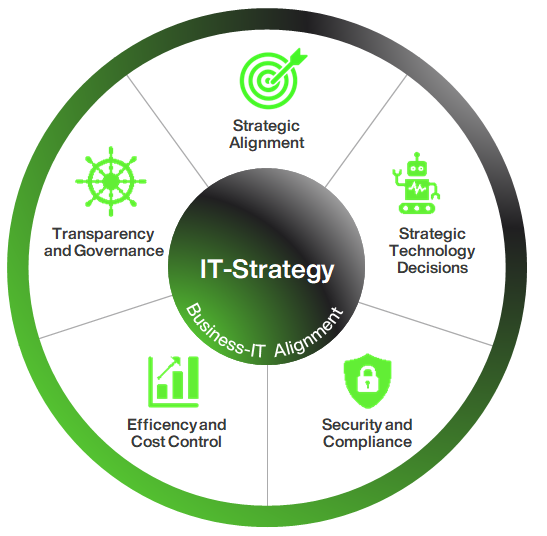
When does IT strategy consulting add value?

Strategic alignment: When IT initiatives are not clearly aligned with business objectives, new business models emerge, or your organization needs to be prepared for the future.

Technology decision‑making: When new technologies such as cloud or AI need to be assessed and introduced in a targeted way, or when legacy systems require modernization.

Security and compliance: When regulatory requirements increase, industry‑specific standards must be met, or cyber threats continue to grow.

Efficiency and cost control: When IT cost transparency is lacking, IT budgets need optimization, investments must become more predictable, or redundant systems should be reduced.

Transparency and governance: When priorities, roles, and responsibilities are unclear, or missing KPIs and governance structures hinder effective decision‑making.

Download factsheet

Still have questions?

Marco Stehlin is there for you.