Skip to content

ITSM Optimization

IT Service Management Optimization Optimization

More than just a ticketing tool

In today’s digital organizations, IT is mission‑critical. When IT services are unavailable or slow to respond, productivity drops, frustration rises, and business processes stall. High-performing organizations therefore rely on structured, efficient, and scalable IT Service Management (ITSM).
ITSM is not just about implementing a tool. Real value is created when processes, organization, and technology are aligned with business needs. We help you move beyond ticket handling towards a service‑oriented IT that delivers measurable impact.

  • create transparency

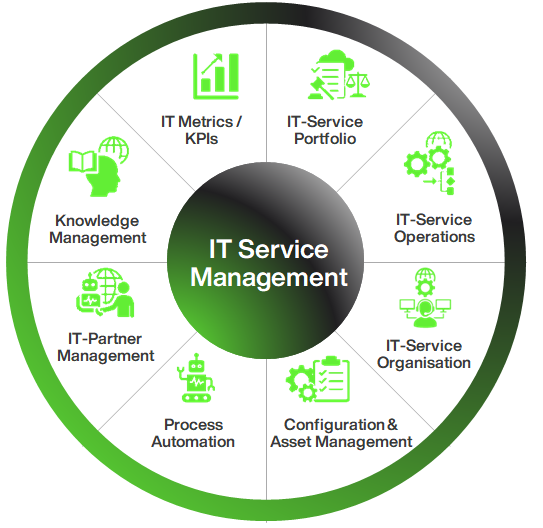
    IT service portfolio

    Transparency about what IT delivers – creating a shared understanding between IT and the business and enabling measurable performance.

  • define clear processes

    IT service operations

    End‑to‑end service thinking to reduce handovers, accelerate response times, and stabilize operations.

  • team

    Aligned IT organization

    Roles, responsibilities, and structures tailored to your services and operational reality.

  • identify dependencies and impact

    Configuration & Asset Management

    Full visibility of the components behind your services – enabling control, stability, and informed decisions.

  • Self-service management

    Process automation

    Acceleration of defined, goal-oriented processes, for example through self-service portals. 

  • end-2-end

    IT partner management

    Seamless collaboration with external partners as part of your service delivery model.

  • documentation and continuous sharing

    Knowledge management

    Linking services with process documentation, solution descriptions, troubleshooting guides, and manuals.

  • Key Performance Indicators

    KPIs & Transparency

    Clear metrics to monitor performance, identify bottlenecks, and drive continuous improvement.

ITSM

When does ITSM optimization make sense?

Insufficient service quality: Excessive lead times for requests, incorrect prioritization, unclear responsibilities, and service disruptions.

Overloaded IT staff: Too many requests and incidents without clear process structures lead to constant firefighting, ad-hoc work, political prioritization, inefficiencies, and high frustration within IT teams.

High IT operating costs: IT operating costs appear high, while transparency on cost structures is lacking. Root causes – such as a high number of cases, supported workplaces, or required licenses – cannot be clearly identified.

Lack of transparency: Missing defined and measurable metrics regarding quality, lead times and SLAs, incidents, problems, changes, service requests, inventory (hardware & software), versions, and costs.

Existing ITSM solution with limited value: No defined service portfolio with documented end-to-end processes. Multiple isolated IT tools instead of an orchestrated ITSM solution. A well-known ITSM suite implemented instead of a service-oriented ITSM approach.

Download factsheet

Still have questions?

Lionel Albrecht is there for you.